The Maldives is the most misunderstood luxury destination on earth. Visitors arrive expecting paradise and often find something more complicated — and more extraordinary — than they imagined.
The Myth and the Reality
The Maldives has been selling the same dream for forty years: turquoise water, white sand, an overwater bungalow, and absolute solitude. The dream is not false — it is simply incomplete. The archipelago of 1,200 islands spread across 90,000 square kilometres of the Indian Ocean is one of the most ecologically complex and culturally layered places on earth, and the luxury resorts that have colonised its most photogenic atolls represent only one dimension of a destination that rewards deeper engagement.
The first thing to understand is geography. The Maldives is not a single place but a chain of 26 atolls stretching 900 kilometres from north to south. The North Malé Atoll, closest to the international airport, contains the most accessible and most densely developed resorts — Baros, Anantara Veli, Niyama. The further south you travel, the more remote and more extraordinary the experience becomes. Soneva Jani in the Noonu Atoll requires a seaplane transfer of 35 minutes; Soneva Fushi in the Baa Atoll UNESCO Biosphere Reserve takes 25 minutes by seaplane. These extra minutes in the air are among the best investments in travel.
Choosing Your Atoll
The North Malé Atoll is the gateway — convenient, well-developed, and home to some of the archipelago's most established resorts. Baros is the classic choice: intimate, beautifully managed, with a house reef that is among the finest in the country. Anantara Veli is the best choice for divers, with access to some of the strongest currents and most diverse marine life in the North Malé Atoll. For those who want the full overwater experience without the seaplane transfer, the Four Seasons Kuda Huraa offers a compelling combination of accessibility and luxury.
The Baa Atoll, designated a UNESCO Biosphere Reserve in 2011, is the destination for manta ray encounters. Between June and November, the Hanifaru Bay marine protected area hosts the largest known aggregation of manta rays in the world — hundreds of the animals feeding in a single lagoon. The Four Seasons Landaa Giraavaru and Soneva Fushi are the two finest resorts in the atoll, and both offer guided snorkelling trips to Hanifaru Bay during the season.
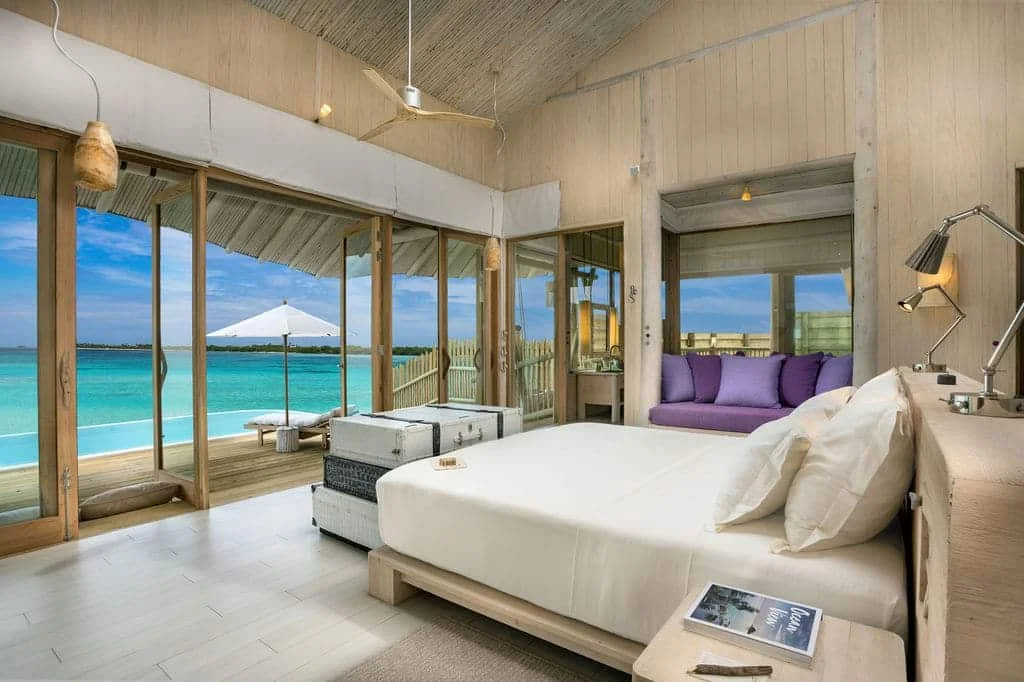
The Noonu Atoll, home to Soneva Jani, represents the furthest point of accessible luxury in the northern Maldives. The resort's overwater villas — some with private pools and retractable roofs for stargazing — are the most extraordinary accommodation in the archipelago. The atoll's remoteness means the house reef is largely undisturbed, and the bioluminescent plankton that lights the water at night is a phenomenon that guests describe as genuinely life-changing.
The Overwater Villa Question
Every guest arrives with the same question: overwater or beach? The honest answer is that it depends entirely on what you want from the experience. Overwater villas offer direct access to the lagoon from a private deck — the ability to slip into the water at dawn without encountering another person is a genuine luxury. The best overwater villas, like those at Soneva Jani and the Waldorf Astoria Maldives, have glass floors that allow you to watch the fish below while you eat breakfast.
Beach villas, by contrast, offer more privacy from neighbouring villas, larger gardens, and in many resorts, better access to the house reef. At Soneva Fushi — widely considered the finest resort in the Maldives — the beach villas are significantly larger than the overwater options and come with private pools, outdoor bathrooms, and the kind of barefoot luxury that the brand has made its signature. The resort's no-shoes policy, in force since its opening in 1995, remains the most elegant statement of intent in Maldivian hospitality.
When to Go
The Maldives has two seasons: the dry northeast monsoon (November to April) and the wet southwest monsoon (May to October). The dry season is the peak season — calmer seas, clearer skies, and the best conditions for diving and snorkelling. The wet season is not, as many assume, a period of constant rain — it brings more cloud cover, occasional squalls, and significantly lower rates at most resorts.
The optimal window for the Baa Atoll manta ray aggregation is June to November — which falls entirely within the wet season. This creates an interesting choice: the best wildlife experience coincides with the lower-season rates and slightly less predictable weather. For most travellers, the manta rays are worth the trade-off.
The Editor's Verdict
The Maldives rewards specificity. The guests who are disappointed are almost always those who chose a resort based on price or proximity to the airport rather than on what they actually wanted from the experience. The guests who return — and the Maldives has an extraordinary rate of repeat visitors — are those who understood that the archipelago is not a single destination but a collection of micro-worlds, each with its own character, its own marine ecosystem, and its own version of paradise.
Our recommendation: if this is your first visit, choose Soneva Fushi or the Four Seasons Landaa Giraavaru in the Baa Atoll and time your trip for the manta ray season. If you have been before, go further — the Noonu Atoll, the Raa Atoll, the Lhaviyani Atoll. The Maldives you have not yet seen is always more extraordinary than the one you already know.
Our editors travel extensively to verify every recommendation. All hotel reviews are independent — we accept no payment for editorial coverage.