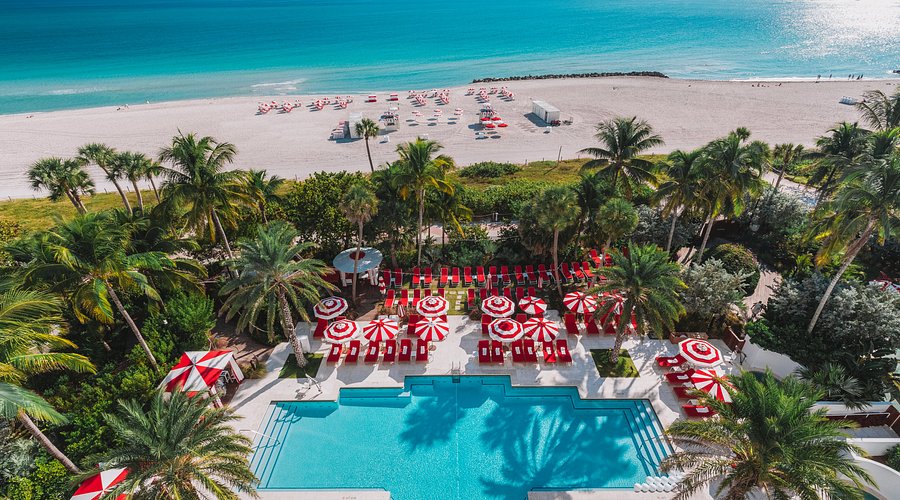
Miami Beach is the most photogenic hotel destination in the United States — a city where Art Deco architecture, tropical light, and the Atlantic Ocean combine to create a backdrop that no other American city can match.
The South Beach Paradox
South Beach is simultaneously one of the world's great hotel destinations and one of the world's most overhyped. The Art Deco Historic District — the 1930s and 1940s buildings that line Ocean Drive and Collins Avenue — is genuinely extraordinary: a concentration of architectural beauty that rivals anything in Europe. But the neighbourhood's reputation for excess, noise, and the kind of conspicuous consumption that mistakes spending money for having taste has driven many of the world's most discerning travellers to look elsewhere.
The answer, for those who want Miami Beach's extraordinary light and ocean access without the South Beach circus, is to stay in the Mid-Beach or North Beach neighbourhoods — or to choose one of the handful of South Beach hotels that have managed to create an oasis of calm within the chaos.
Faena Hotel Miami Beach: The Total Work of Art
Alan Faena's hotel on Collins Avenue is the most theatrical hotel in the United States. The Argentine developer and his collaborators — the designer Lenny Kravitz, the artist Damien Hirst, the architect Rem Koolhaas — created a hotel that is simultaneously a luxury property, an art installation, and a performance. The gilded woolly mammoth skeleton in the lobby (a Damien Hirst original) sets the tone: this is a hotel that takes nothing seriously except the pursuit of pleasure.
The Faena's 169 rooms are among the most dramatically designed in Miami: a collaboration between Baz Luhrmann's production designer Catherine Martin and the hotel's creative team that draws on Argentine estancia aesthetics, Hollywood glamour, and Miami's own particular brand of tropical excess.
The Setai: Asian Serenity on the Atlantic
The Setai Miami Beach occupies a 1936 Art Deco building on Collins Avenue that has been transformed into one of the most serene hotels in the United States. The hotel's aesthetic — a collaboration between the Singapore-based designer Jaya Ibrahim and the Setai's founders — draws on the traditions of Southeast Asian luxury: dark teak, stone floors, and a palette of charcoal and gold that feels simultaneously ancient and contemporary.
The hotel's three pools — each maintained at a different temperature, arranged in a cascade from the building to the beach — are the finest hotel pool complex in Miami. For travellers who want Miami Beach's extraordinary location without its characteristic noise, the Setai is the essential choice.
The Editor's Verdict
Miami Beach is best experienced in the shoulder seasons — October to November and March to April — when the weather is perfect, the humidity is manageable, and the summer crowds have not yet arrived. The city's cultural life, which has expanded dramatically since the establishment of Art Basel Miami Beach in 2002, is at its most vibrant in December.
For a first visit, the Setai provides the most complete Miami Beach experience: extraordinary architecture, exceptional service, and a location that puts guests within walking distance of the city's best restaurants, galleries, and beaches.
Our editors travel extensively to verify every recommendation. All hotel reviews are independent — we accept no payment for editorial coverage.